
What Does Zeus Mean in the Bible?
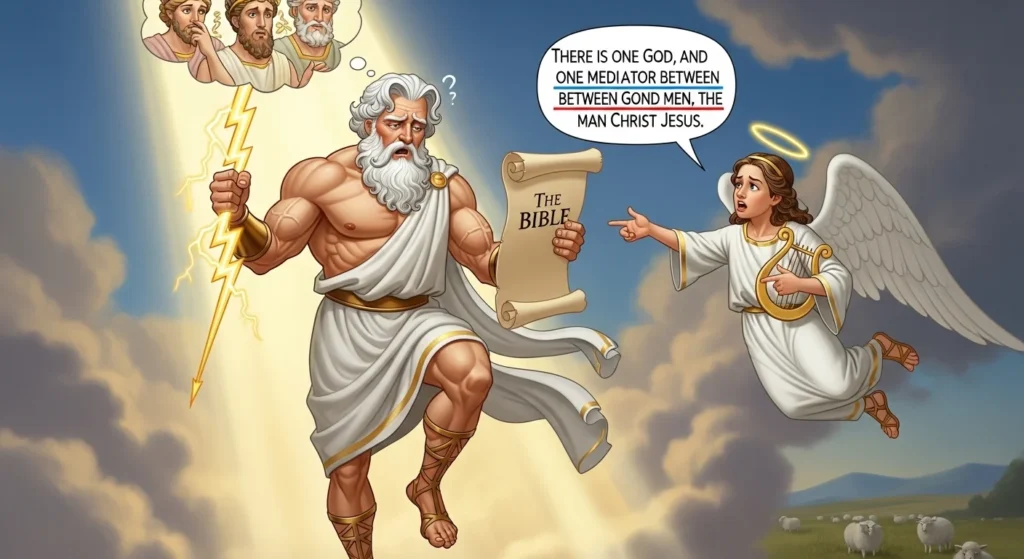
Zeus meaning in Bible was the chief god in Greek mythology, worshiped as a powerful deity by many in the ancient world. In the Bible, Zeus meaning in Bible is referenced to highlight human misunderstanding and the tendency toward idol worship.
Spiritually, Zeus meaning in Bible represents false beliefs and man-made gods, reminding believers to remain faithful to the one true God, Yahweh, who alone deserves worship.
Bible Verses About False Gods and God’s Supremacy Zeus Meaning in Bible
1. Acts 14:11-12 (NIV)
“When the crowd saw what Paul had done, they shouted… ‘The gods have come down to us in human form!’ Barnabas they called Zeus…”
This shows how people mistakenly worshiped humans as gods, revealing confusion about the true God.
2. Exodus 20:3 (NIV)
“You shall have no other gods before me.”
God commands exclusive worship, contrasting with belief in gods like Zeus.
3. Isaiah 45:5 (NIV)
“I am the Lord, and there is no other; apart from me there is no God.”
This affirms God’s uniqueness and supremacy over all false gods.
4. 1 Corinthians 8:4 (NIV)
“We know that ‘An idol is nothing at all in the world’…”
False gods like Zeus have no true power compared to God.
5. Psalm 96:5 (NIV)
“For all the gods of the nations are idols, but the Lord made the heavens.”
This highlights the difference between man-made gods and the Creator.
6. Acts 17:24-25 (NIV)
“The God who made the world and everything in it is the Lord of heaven and earth…”
God is sovereign over all creation, unlike mythical gods.
7. Deuteronomy 6:14 (NIV)
“Do not follow other gods, the gods of the peoples around you.”
Believers are warned against adopting pagan beliefs.
8. Jeremiah 10:11 (NIV)
“The gods that did not make the heavens and the earth will perish…”
False gods are temporary and powerless.
9. Galatians 4:8 (NIV)
“Formerly, when you did not know God, you were slaves to those who by nature are not gods.”
This reflects spiritual bondage to false beliefs.
10. Revelation 22:9 (NIV)
“Worship God!”
The Bible consistently calls believers to worship the one true God alone.
Theological Insights
Acts 14:12 (NIV) – Zeus is mentioned as a false identification of divine power.
Psalm 115:4-8 (NIV) – Idols are lifeless and powerless compared to God.
Isaiah 44:9 (NIV) – Idol worship is described as empty and without truth.
These passages show that Zeus represents false worship, human misunderstanding, and the contrast between idols and the living God.